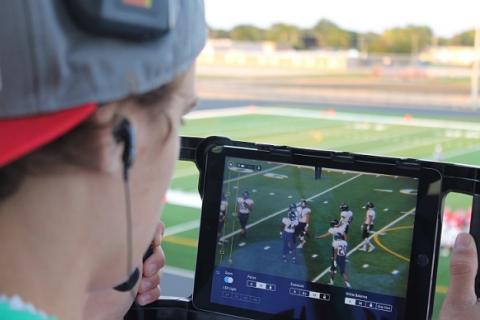
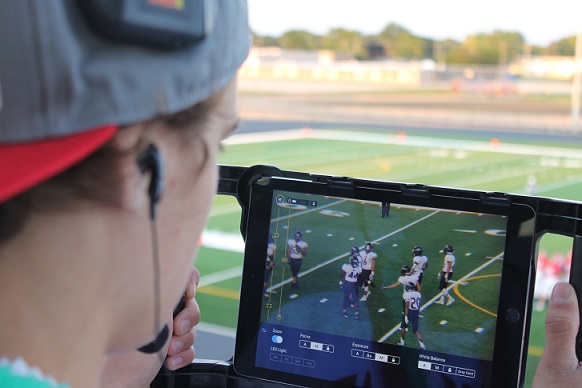
Friday night's ground-breaking, multi-camera video cast on WGTD's Facebook page of the Bradford/Tremper cross-town rivalry will stand atop 15 years worth of innovation and dedication from an enthusiastic crew of adult volunteers, students and WGTD staff members.
Shortly after becoming station manager in late 2001, David Cole was approached by several area schools that wanted WGTD 91.1 FM to fill a void and consider broadcasting local sports.
How do you preempt classical music without ticking off WGTD's primary audience? The answer is you don't.
Taking advantage of relatively new technology, Gateway Technical College's IT Dept. created gatewaysportsweb.org--a live audio internet stream accessible to anyone with a computer.
Next, Sportsweb decided to pass up the usual cell-based remote broadcasting gear commonly used by radio sportscasters. A device called a Matrix was purchased. Using codec technology, the Matrix gave the webcasts a you-are-there, studio-like quality.
In 2002, Bill Fritsch and Bob Haggarty--driving forces behind Sportsweb--launched the service during the 2002 high school football season.
From the start, the multi-faceted goal was to give exposure to local sports, produce an entertaining broadcast and give students experience either in front of the mic or behind the scenes. For example, students from Gateway's now-defunct broadcasting program were given a wireless mike and sent out to do interviews with coaches and fans. The interviews may have been less than compelling, but students were grateful for some real-life broadcasting experience.
There were challenges.
For example, the Matrix--as good as it was-- relied on POTS--an acronym for plain old telephone service. A simple matter if the stadium press box that you were in had a phone jack. Not so easy if it didn't.
But the lack of a phone connection never deterred the Sportsweb crew from webcasting key match-ups--especially those important playoff games where no other coverage was being offered.
Spools of thin phone wire were purchased that sometimes had to be strung on the ground for blocks to the nearest phone jack.
At a hot playoff game In Oak Creek on an unseasonably cold Saturday afternoon in October, yards of cable had to be laid from the press box, across a field, over tennis courts, through a parking lot, behind a dumpster and into an elementary school. A gracious and sympathetic school administrator had agreed to leave the back door open to allow Sportsweb to access the main office with its phone jacks.
Cole assigned himself to cover the most important assignment of the day: Protecting the cable.
The afternoon was not without worry. From his heated jeep parked in the mostly-deserted parking lot, Cole spotted a man suspiciously ducking behind the dumpster--a few feet from the cable and the open school door. But a stream of liquid emerging from beneath the dumpster signaled the man's true intention of seeking relief rather than wanting to cause mischief--- before he headed out to the stadium to watch the game.
A short while later, another unexpected sight in his rearview mirror: A couple of bundled-up tennis players taking advantage of one of the few remaining days of the season. A scramble ensued to reposition the wire to save the day.
We don't remember who won that important playoff game--or even who the teams were--but we do recall accomplishing the mission at hand.
A few years later, another 'it-can't-be-done' effort was launched: Sportsweb audio was paired with video.
Long-time video aficionados Mike Love, Mike Kehoe and Greg Kishline joined the team to assemble and help operate some inexpensively-obtained video gear. Greg built a cart for the less-than-state-of-the-art video switcher and old VHS recorders. The cart was pushed up a custom-built ramp into a spare Gateway mini-van, instantly creating a mobile studio.
Video productions of both football and basketball games spanned several seasons, but the labor-intensive effort was eventually abandoned to await the advent of the hoped-for next generation of video technology.
That moment came unexpectedly in 2016 when Facebook launched its live video streaming app. WGTD staffer Troy McDonald started experimenting just hours after the app's release, and the wheels started turning again.
These days, WGTD Sports Live on Facebook gives local sports fans a three-camera look at the action with longer lenses, graphics, video cut-a-ways, audio from the field and stands, and of course, Bill and Bob in the press box. The production is controlled by inexpensive, touchscreen software that's actually embedded into the screen of one of the iPods. The six-person crew includes two students from Indian Trail.
Gatewaysportsweb.org remains active with audio-only sports coverage. A broadcast crew that lost its 'home' when Racine's WRJN discontinued sports coverage can now be heard on the old stream. Sportsweb greatly increased its mobility with the advent of smart phones and the free WGTD phone app. Downloadable wherever you get your apps, listeners are no longer tied to their desktop or laptop computer.
For all of our game schedules, visit gatewaysportsweb.org.
-0-
.