Oct. 16, 2025 10:30a
(WGTD)---A co-curricular activity at Carthage College has turned heads, raised revenue and created new learning opportunities.
The school’s space sciences program grew from the modest request nearly 20 years ago of a few Carthage students to enter a competition run by NASA. The entry didn’t place, but a few weeks later Carthage physics professor Kevin Crosby unexpectedly received a call from NASA inquiring whether the school was interested in other NASA projects.
These days, teams of students are working on several projects, all tied to NASA’s quest to re-use rockets and find ways to refuel them in space, initiatives to make possible longer space missions. The work is at the intersection of physics, electronics and astronomy.
The important thing for the students is the skills they develop along the way. "They need to learn not just the technical skills but also the soft skills and how to relate to people," he said. "They learn project management skills. How to take an idea from a piece of paper to a product and do it on a schedule with a budget. Whatever they do in life, these are translatable skills and capacities that are very important."
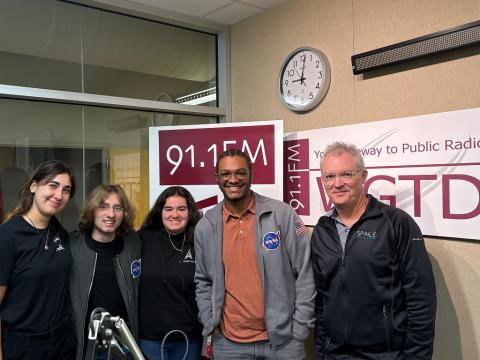
Speaking on WGTD’s The Morning Show, Crosby said the students get excited because they’re looking for solutions for real problems that are encountered in space travel. "When you work in an environment that has a purpose and a mission and you connect to that purpose and mission you're going to embody it in everything," Crosby said. "A lot of us eat, drink and sleep this stuff."
Crosby not only guides Carthage’s space sciences program but he also heads up the Wisconsin Space Grant Consortium.
Carthage recently won a prize that’s expected to fund new research of up to a half-million dollars. The money will enable the student researchers to build an experimental payload with the opportunity to test it on a suborbital flight. The team needs to deliver the hardware for testing by April 1st of next year.
Crosby said NASA has historically used schools around the country as a backbone for its research. Only relatively recently has NASA reached out to smaller schools like Carthage.
-0-