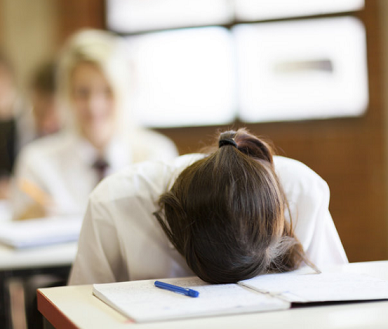
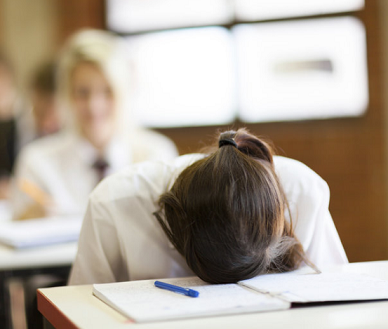
If you’re a high school student in the WGTD listening area, chances are you’re getting up and heading off to school well before sunrise these days.
If you think that’s just not right---you’ve got plenty of company. Both the American Academy of Sleep Medicine and the American Academy of Pediatrics recommend that high schools and middle schools start no earlier than 8:30.
With first period bells that ring at 7:15, Racine Unified would appear to have some of the earliest high school starting times in the area. According to statistics presented on WGTD's Education Matters, fewer than 10% of the nation's high schools start before 7:30. That's based on a six year-old survey of over 18,000 schools nationwide.
In Kenosha Unified, first period classes start at 7:30.
Speaking on Education Matters, an expert on the matter, Jack Peltz of the University of Rochester Medical Center, says a lot could be gained by allowing students to sleep in. "An overwhelming majority of adolescents are either getting insufficient sleep or poor quality sleep," Peltz said. "And that ultimately has a real negative affect on their behavior from not only their psychological functioning but also their academic performance to even driving while drowsy and potential car crashes," he said.
So what’s stopping school districts from heeding the advice of the experts?: Economics and athletics, it seems. At least that was the case in Racine Unified which recently weighed the pros and cons of earlier start times.
Some people were concerned over the impact of early starts and later releases on after school jobs, athletic practices and home schedules. While the matter is still being looked at, district spokesperson Stacy Tapp says earlier start times, for the moment at least, don’t appear to be in the cards.
However, it may be just a matter of time before Racine Unified and other schools with early start times bite the bullet as pressure increases for higher student achievement and better attendance, and as the body of research on the matter grows. "If we think of adolescents as a national resource--and they are an incredible resource--if we don't take care of them then we're going to lose out," he said.
The complete conversation with Peltz is here.
-0-