Oct. 1, 2025 9p
(WGTD)---Outgoing Kenosha Innovation Neighborhood Board Chairman Tim Mahone might’ve said it best: A land of pain has turned into a land of gain.
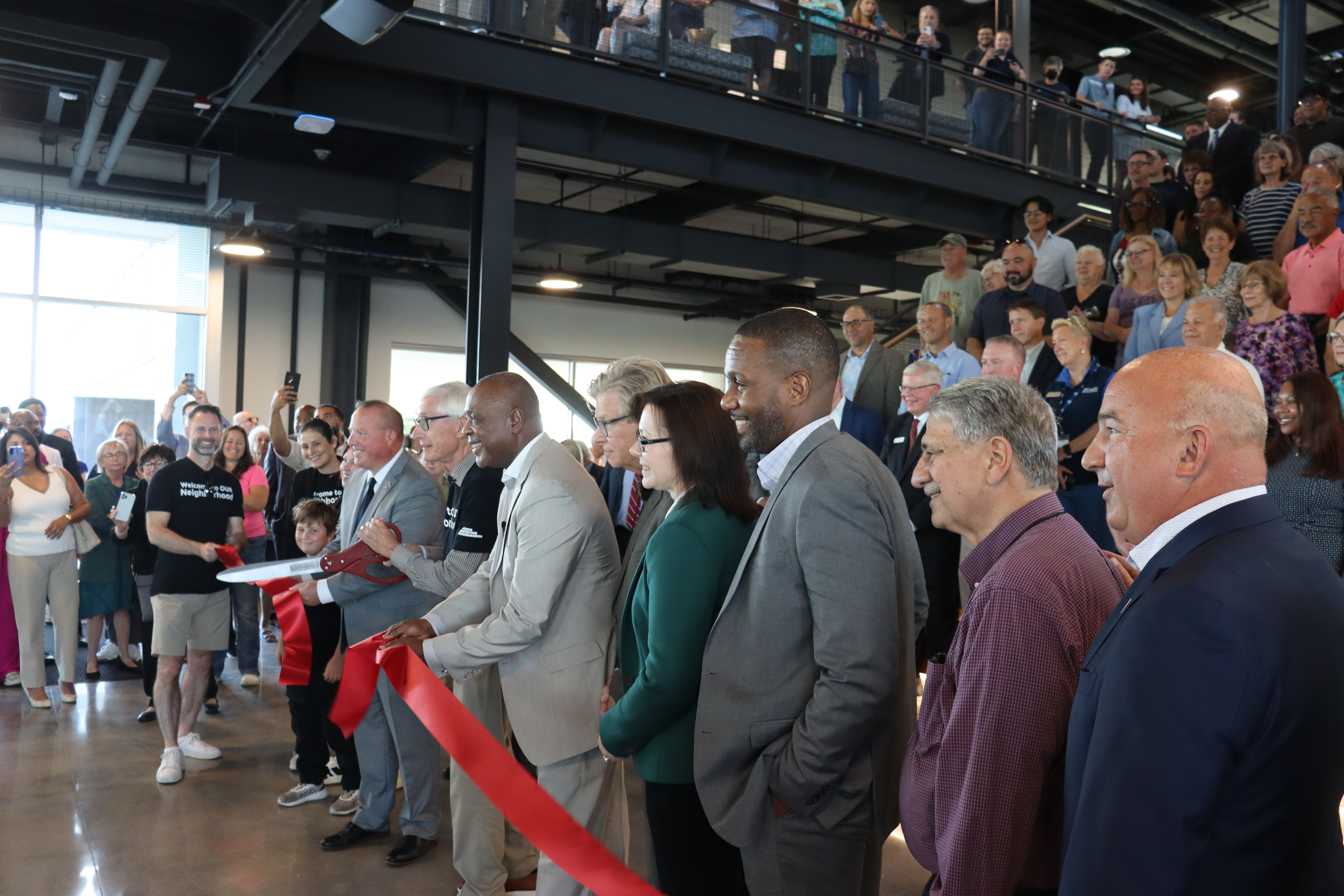
Mahone was one of the speakers at a ribbon-cutting ceremony Wednesday for the Kenosha Innovation Center, the flagship building in the 109-acre Kenosha Innovation Neighborhood, going up on land that was once home to Kenosha’s auto industry.
When auto assembly ended in 1988, resulting in the layoff of thousands of disappointed and angry workers, and the left-over Engine Plant closed 12 years later, a process slowly evolved that led to the creation of KIN.
It was the brainchild of former Kenosha Mayor John Antaramian, who was in the front row for the ceremony. “I’m just excited about what has occurred and all of the people that have some together to make this happen,” Antaramian told WGTD. “It’s a wonderful opportunity for the community and a wonderful opportunity for our young people who will have opportunities entrepreneurship and education.”
The new Center was paid for in part with a $14 million grant from the state, something that was highlighted by Gov. Evers in his remarks. “This is a win-win project,” Evers said. “There are not many like that.”
KIN Executive Director Kelly Armstrong said the Center is opening with about ten tenants, including a biotechnology consulting firm, an insurance company, a venture capital company, UW-Parkside and Carthage College. “We’re opening at about 20% occupancy,” she said. “What’s really exciting about that is we have the right mix of companies. Now our job is to scale that mix and grow it from here.”
Offices will be built to suit a tenant’s need, in spaces that currently sit empty around the core of the building, the center of which is a three-story atrium that doubles as an auditorium. The upper-most level features two outdoor patios.
The ribbon-cutting had a personal element for Milwaukee attorney Art Harrington. Harrington—a fifth generation Kenoshan—played a strong role in a Chrysler bankruptcy court fight that led to the City of Kenosha gaining control of what eventually would become KIN. For a time, it looked as if Chrysler would abandon the site and leave millions of dollars worth of environmental remediation up to the city.
In the end, the bankruptcy court yielded a favorable ruling for the city and both the federal and state governments pitched in and KIN was born.
Although he could’ve walked away with a satisfying legal and political victory under his belt, Harrington hung around, providing guidance to the city as it developed KIN, then sitting on the board of the non-profit that now controls the new development. “Kenosha runs through my blood,” said Harrington. “Anybody who grows up here has a strong affinity to what the challenges here have been…to see this kind of renaissance and to be part of it…it’s a once in a lifetime opportunity. I would pay to do this,” he said.
KIN”s long-term goal is to attract entrepreneurs and high-tech industries that’ll lead to new job opportunities for Kenosha’s young people in a work-live-play atmosphere.
-0-