Mar. 17, 2026 12:30p
(WPR)---It’s a cold evening in Racine, but it’s warm inside the local library where a group of volunteers is gathering for a weekly meeting.
Bobby Ayala drags chairs into a circular formation. Roughly half a dozen people file in, and Ayala calls them to order.
“Hello, everybody,” Ayala said. “We are not lawyers. Welcome to the hub. My name is Bobby. I am directly impacted.”
Ayala is now on parole after spending nearly 30 years in prison on charges including reckless homicide. He’s among the leaders of a grassroots group that’s practicing what’s known as participatory defense.
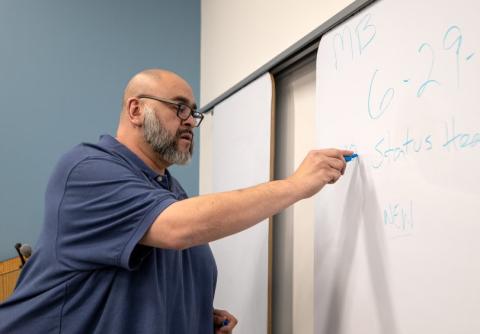
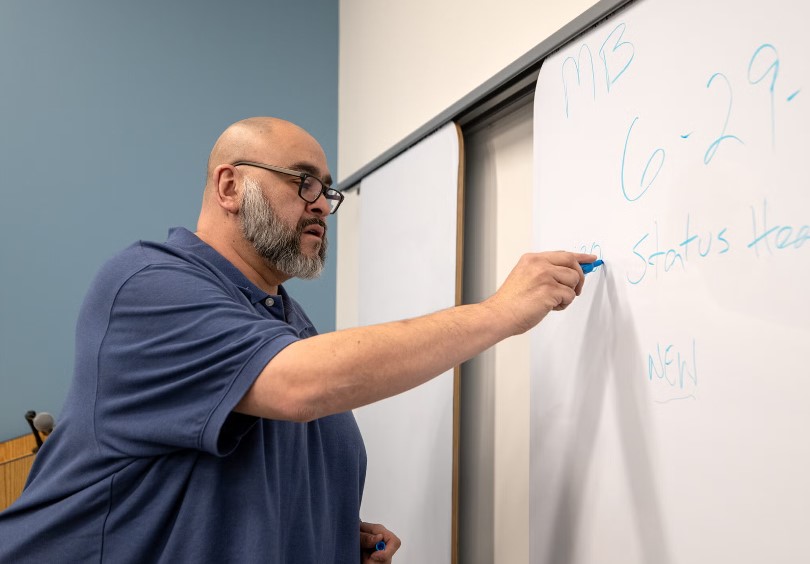
At the start of the meeting, Ayala writes a few case numbers on a whiteboard, and shares updates with the group. For many hub members, the list is not just a series of letters and numbers. It’s personal.
People reach out to Racine’s hub when they — or their loved ones — are facing criminal charges.
Ayala remembers being in their shoes. When he was sentenced to prison at age 19, he remembers sitting in a Racine County courtroom, feeling mostly alone.
“I was a teenager looking behind me, and there’s a lot of angry people and one family member,” Ayala said. “They didn’t know what’s going on. I didn’t know what was going on. When the judge sentenced me, I was more confused than probably anybody in the courtroom.”
Ayala believes things would have been different if he had access to people who could explain the legal process, and advocate for him on a personal level — the kind of work he does now for others through Racine’s participatory defense hub.
Racine’s group is part of a growing national movement
The goal of participatory defense is to harness the often-overlooked expertise of community members, says Charisse Domingo, an organizer with the National Participatory Defense Network.
“Our knowledge and experience is just as valuable (as) any three letters … that define a degree,” Domingo said.
The idea for participatory defense grew out of Silicon Valley De-Bug, a California-based nonprofit, in the early 2000s.
Since then, the model has spread.
Although Racine’s hub is the only one in Wisconsin, there are now more than 50 local groups practicing participatory defense nationwide.
“The magic that happens at Racine happens pretty much every day of the week around the country,” Domingo said.
In some communities, hubs work with people facing eviction in housing courts. Others support people through immigration proceedings.
Racine’s hub has focused on people dealing with criminal courts — mostly in Racine and Kenosha counties. The group also oversees a crowdsourced bail fund, which it uses to help participants get out of jail while cases are pending.
Leaders of Racine’s hub are quick to point out that they can’t offer legal advice. But the core members — who include a Presbyterian pastor, parents and longtime residents — all have deep connections to the community.
Some, like the hub’s co-founder Carl Fields, have knowledge that comes from having gone through the criminal justice system themselves.
“I’m old now — I’m almost 50,” said Fields, a Racine resident who spent 16 years in prison. “I have a lot of life experience, a lot of wisdom to pour into my community. And, like I always said, I owe my community a lot more than a prison sentence.”
Humberto Delgado reached out to the Racine hub when his 18-year-old son was charged with theft with a dangerous weapon.
At the time, Delgado had little experience with the criminal justice system.
“I mean, I got a parking ticket or a speeding ticket, I would investigate and check it out.” Delgado said. “That’s totally different than this.”
Four adults sit at tables in a classroom, facing forward and listening attentively. Notebooks, bags, and personal items are on the tables.
The Delgado family paid for a lawyer, but, at first, Delgado was frustrated. The attorney would not share updates because Delgado’s son was the client — not his parents.
On the advice of hub members, Delgado got his son to grant access, so his lawyer could share case details. And Delgado said the hub helped him figure out what questions he should ask the attorney.
After that, his son’s lawyer “was able to fight for him a lot better,” Delgado said. “That helped quite a bit.”
Many hub participants have public defenders, and those attorneys have heavy caseloads
Across the country, many hub participants have public defenders, says John Gross, a University of Wisconsin-Madison law professor who formerly worked as a public defender on the East Coast.
Public defenders are overworked, and may not have much time to spend explaining each case, he said.
“These lawyers are typically not charged with doing sort of community education and advocacy,” Gross said.
That’s where participatory defense comes in.
Take the process of visiting a loved one in jail. Lawyers get special access to their clients, even when that client is behind bars. But, for family and friends, jail visitation policies are more complicated. Because of their direct experience, hub members can walk someone through that process.
And a big part of participatory defense is holding lawyers accountable, Gross said.
Unlike with a private attorney, people with public defenders don’t get to pick who’s appointed to represent them.
“When I was a public defender for eight years, nobody filled out a survey card about how I did and what they would have liked me to have done differently,” Gross said.
While Gross is an enthusiastic supporter of participatory defense, he acknowledges that some lawyers may have hesitations. For one thing, participatory defense meetings aren’t protected by the same legal privilege that shields conversations between an attorney and their client.
“There are some instances where I think a lawyer might deliberately be, at the very least, cautious about engaging with the hubs,” Gross said.
At some hubs, members teach tactics, designed to help people get calls back from their busy public defenders. That includes copying the lawyer’s supervisor on emails.
Participatory defense is an antidote to the “paternalism,” that’s “long (been) a problem in criminal defense,” Cynthia Godsoe wrote in the Mercer Law Review.
Godsoe is a Brooklyn Law School professor and former public defender. She says there’s often a power imbalance between public defenders and their clients.
Compared to their attorneys, the people facing charges are lower income and they’re more likely to be people of color, Godsoe noted.
“That’s not because they’re the only ones committing crimes,” Godsoe said in an interview. “It’s just they’re the ones who end up in the system.”
In theory, Godsoe said the client’s wishes are supposed to be driving any criminal defense strategy. In practice, she says that doesn’t always happen.
“They’re often told just like, ‘Listen,’” Godose said. “‘I’ll handle it. Don’t speak (in court).’”
Wisconsin State Public Defender Jennifer Bias says lawyers should think of participatory defense as an asset.
“Here at the law firm of the state public defender, we are client centered, and so the client drives the approach,” Bias said.
In Racine, hub members show up physically in the courtroom to support participants. And they reach out to people like the defendant’s boss or pastor, asking them to submit statements about that person’s impact.
Bias says that’s crucial when a judge is sentencing someone or deciding what their bail should be.
“Our Constitution says innocent until proven guilty,” Bias said. “But what I find is that you’re only as innocent as your supporters portray you.”
Racine resident Gwendolyn Shaw-Scott learned about the hub when her son was having trouble paying his bail. His lawyer recommended the hub’s bail fund.
Now, Shaw-Scott is a regular at the hub’s Monday night library meetings. And, on most weekdays, she spends hours just down the street keeping an eye on proceedings inside the county courthouse.
Two people sit at a table in a classroom setting; one types on a laptop while the other is blurred in the foreground, both focused on their tasks.
Gwendolyn Shaw-Scott types on her laptop while attending a participatory defense meeting Monday, Feb. 2, 2026, in Racine, Wis. Angela Major/WPR
Shaw-Scott is Black, and she says, oftentimes, the defendant is one of the only other people of color in the courtroom.
“Most of the time they go before a white judge, you know, white attorneys, white prosecutors,” Shaw-Scott said. “And then the only Black person is sitting there with shackles on.”
Sometimes, Shaw-Scott helps people navigate the maze of the courthouse by directing them to the right courtroom. Other times, she hopes her mere presence in the gallery will act as a show of solidarity.
“As long as I can help someone feel like they are human, that’s my job,” Shaw-Scott said.
Father credits the hub with getting his son a shorter sentence
Before sentencing, the hub helped the Delgado family put together a video that was played in court.
In that video, music plays as Delgado talks about his son’s technical prowess. “He helped me put in furnaces, water heaters,” Delgado said, as he faced the camera. “He could be a good plumber or an electrician.”
Last year, a Racine County judge sentenced Delgado’s son to three months in jail followed by work release. Without the hub, Delgado believes it would have been longer.
When that sentence is done, the hub plans to mark the occasion with a special ceremony.
They’ll write the teen’s name on the library whiteboard, and then let him erase it.
-0-