July 3, 2019 11:30a
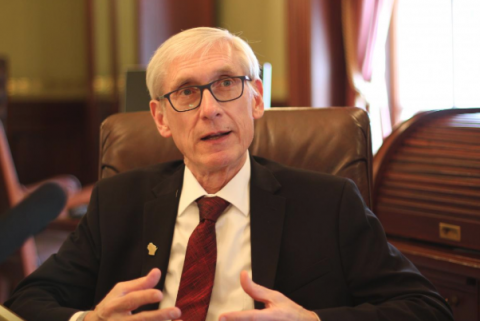
(WPR)---Gov. Tony Evers used his veto pen Wednesday to boost K-12 education funding in Wisconsin by nearly $90 million in the next two-year state budget.
The change was one of 78 partial vetoes Evers made to the $82 billion budget approved last week by Wisconsin’s GOP-controlled Legislature.
"While this budget makes critical investments in areas that were included in The People’s Budget, this is a down payment on the progress we must make in the next biennial budget," the governor said in a prepared statement. "I promised I would put people first, and that is why I am proud we were able to do as much as we did with the budget we were given."
The governor has one of the most powerful veto pens in the country, with the ability to delete words, numbers and punctuation from the state's spending plan.
The boost to education funding means the state will increase K-12 education spending by about $600 million over the next two years. The budget approved by the Legislature had already slated a $500 million increase.
However, even with Evers' $90 million boost, the spending increase is still dramatically less than the $1.4 billion bump Evers proposed earlier this year.
Republicans argued that increase was too expensive for taxpayers.
"It remains critically important that our state address the underfunding of our public school system, and while the increases in this budget are important, they are not enough," the governor said in his veto message.
Evers accomplished the spending bump by increasing per-pupil aid in Wisconsin by $63 per student in each of the next two years. The change, which will cost roughly $87 million, is similar to one requested earlier this week by the Wisconsin Association of School Boards.
WASB sent a letter to the governor requesting a $25-per-pupil increase in the 2019-2020 school year, saying it was necessary to help schools meet rising costs due to inflation.
Republican legislative leaders were quick to criticize the request.
"It’s amazing to me that a coalition group like the Wisconsin Association of School Boards — that wants to be perceived as non-partisan in the Capitol — is encouraging the governor to skirt legislative intent with a veto," said Senate Majority Leader Scott Fitzgerald, R-Juneau, in a tweet on Tuesday.
The governor paid for the education spending increase by zeroing out a number of other proposals in the budget. That includes about $23 million slated to pay for implementation of state work requirements for able-bodied adults who receive public benefits like food stamps.
Those requirements, which were proposed and approved under former Gov. Scott Walker, were set to expand from able-bodied adults without dependents to able-bodied adults with children this fall.
The governor also deleted some programs scheduled to be funded through a so-called "supplemental appropriation" fund overseen by the state Legislature's budget-writing committee. Under the budget, the programs paid for by the supplemental appropriation would require an additional level of approval by the committee. Evers eliminated some Department of Health Services programs from that list, including a $2.8 million telehealth expansion. His office said that program and others have already been or will be funded through a DHS surplus from the previous budget.
Evers also eliminated a vehicle registration fee decrease for large vehicles that would have cost the state $7 million, deleted a $2.5 million state Department of Transportation study on mileage based fees and tolling and eliminated $15 million of a $90-million transfer from the state’s general fund, which pays for education, to the transportation fund.
Evers also used $30 million in savings from a re-estimate of state Medicaid costs to fund the spending bump.
Security Spending Limit For Lieutenant Governor
The governor also used his veto pen to eliminate a cap imposed in the budget on the amount of state money that can be used for Lt. Gov. Mandela Barnes' security detail.
"Inadequate security measures put the brave men and women of law enforcement, the Lieutenant Governor, his staff, and the general public at large in danger," the governor said in his veto message.
Republicans inserted the limit following reports that Barnes' security costs have been higher than those of former Lt. Gov. Rebecca Kleefisch.
Barnes is the first African American to hold the office. A former aide has tweeted in support of the lieutenant governor's security expenses, sharing Barnes regularly received "hateful" messages when he was a state lawmaker.
Direct-To-Consumer Tesla Sales
Evers nixed a last-minute addition to the budget that spurred some controversy at the Capitol: a provision that would allow Tesla vehicles to be sold directly to consumers in Wisconsin, without a car dealership acting as an intermediary.
"I am vetoing this provision as I object to significant changes to existing motor vehicle dealership law and the consumer protections they provide to Wisconsin occurring late in the state budget process and without the opportunity for adequate public input and debate," the governor said in his veto message.
The proposal was added to the budget during final deliberations by the state Assembly. It was seen by some as a move to lure GOP Sen. Chris Kapenga, R-Delafield, into supporting the budget in the Senate, where the plan faced a slim margin for passage.
Kapenga had pushed for the Tesla law change in previous legislation.
Shared Revenue For Milwaukee County
The governor also vetoed a provision in the budget that would have cut about $7 million in state aid to Milwaukee County for child welfare services in 2020-2021.
The reduction spurred debate within the state Legislature’s budget-writing committee, as Republicans argued it is unfair for Milwaukee to receive the state support while other counties do not.
In his veto message, the governor said he restored the funding because cutting it "does nothing to improve the lives of children and their families."
"The immediate and only result of this reduction in shared revenue will be cuts to vital government services provided by Milwaukee County, and this leaves the county little time to prepare for these cuts," he wrote.
Local Regulation Of Quarries
The governor also eliminated a proposal from the budget that would have blocked local governments from regulating blasting at rock quarries without state approval.
The proposal, which was similar to one vetoed by former Gov. Scott Walker in 2017, would also have prohibited local governments from creating air and water quality standards.
"I am vetoing these sections because I object to this change to local authority occurring without the opportunity for public debate outside of the budget process," the governor said in his veto message.
Supporters of the measure have said local regulations, which can govern things like operating hours, are onerous and go far beyond state and federal rules.
New High-Security Prison In Green Bay
In another move, Evers eliminated a $5-million earmark for a state land purchase in Green Bay. The money was specified for land intended to house a new maximum security prison.
Evers did not eliminate the $5 million from the state Department of Corrections budget, but deleted the requirement that it must be spent on the land purchase for the prison.
"I am partially vetoing this provision because I object to building a new maximum security correctional facility as we continue to explore needed criminal justice reform in Wisconsin," he said in his veto message. "The current population pressures facing the Department of Corrections are being experienced primarily in minimum and medium security facilities, and while I am supportive of finding a solution to these pressures, I am not supportive of the insertion of a project for the construction of a new maximum security correctional facility late in the budget process and without the opportunity for more robust public input."
Capitol Security Study
The governor also deleted a study of state Capitol security, which Republicans proposed to be completed in cooperation with the Madison Police Department.
During committee debate, Democrats pushed back on the proposal, saying Republican lawmakers behind the plan were placing a burden of the city of Madison without adequately consulting with local law enforcement about the plan.
"While I strongly support ensuring the safety of visitors and employees who come to the State Capitol, I object to releasing information about potential security vulnerabilities in a public report as it would negate the very efforts of this study," the governor said in his veto message.
The governor, noted, however that he is directing Capitol Police to "review and update, if necessary, its existing plans for the security and safety of the State Capitol, including input from the Madison Police Department."
Editor’s Note: This story will be updated.
Wisconsin Public Radio, © Copyright 2019, Board of Regents of the University of Wisconsin System and Wisconsin Educational Communications Board.